We are delighted to announce Dr Srikanth Sadhu as a touchIMMUNOLOGY Future Leader 2026, selected by peers as one of the immunologists changing the future of viral immunology.
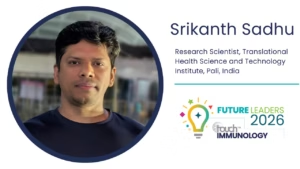
Dr Srikanth Sadhu is a research scientist in the Department of Immunobiology and Immunotherapy and the Immunology Core Laboratory at the Translational Health Science and Technology Institute (THSTI), India, whose work focuses on host–pathogen interactions, cytokine biology, and immune engineering to develop new therapies for infectious diseases.
Dr Sadhu has made notable contributions to understanding immune drivers of severe viral infections, including SARS-CoV-2, and has led the discovery of host-directed antiviral compounds with broad therapeutic potential. Recognized internationally for his impact in immunology, he was selected for the prestigious IUIS Rising Stars Award in 2025.
In this Q&A, Dr Sadhu reflects on what first drew him to immunology, the defining breakthroughs in his research, and the legacy he hopes to leave in the field of immunology.
What inspired you to pursue a career in immunology?
My journey into immunology began with deeply personal questions. As a child, I witnessed serious illnesses in my family and wondered why the same disease could affect people so differently; why some recover quickly while others deteriorate. This curiosity led me to biology, and eventually to immunology, where I found answers rooted not just in pathogens but in how the immune system is regulated. I became particularly interested in how simple factors, including diet, influenced immune responses. Today, my work focuses on understanding and reprogramming immune pathways; I see immunology not just as science, but as a way to meaningfully change disease outcomes. Immunology, to me, is not just descriptive biology but a framework for designing interventions that can reshape disease outcomes.
Can you share a defining breakthrough in your research and how it impacted your field?
A defining shift in my research has been moving from viewing the immune system as a passive responder to recognizing it as a decisive driver of disease severity. We demonstrated that IL-9 signalling worsens SARS-CoV-2–induced lung inflammation, identifying it as a therapeutic target. During the COVID-19 pandemic, we were also among the early groups to report cardiovascular complications linked to infection and contributed to preclinical evaluation of indigenous vaccine candidates. Building on this, I developed host-directed antivirals using alkaloid-derived compounds that block viral entry across multiple pathogens, reinforcing immune dysregulation as a central, targetable cause of disease.
What legacy do you hope to leave in the field of immunology?
I aim to contribute to a paradigm shift where immunology is not only used to understand disease but to engineer therapeutic solutions. My goal is to establish host-directed, broadly applicable strategies that remain effective despite pathogen diversity and evolution. I also hope to train scientists who think mechanistically and translationally, bridging fundamental biology with clinical need. Ultimately, I want my work to help position immunology as a discipline that actively shapes how we treat emerging and re-emerging infectious diseases.
More content in immunology.
Cite: Dr Srikanth Sadhu on advancing viral immunology through immune engineering: touchIMMUNOLOGY Future Leaders 2026. touchIMMUNOLOGY. 21 May 2026.
This short article was prepared by touchIMMUNOLOGY in collaboration with Dr Sadhu. No fees or funding were associated with its publication.