The 33rd edition of United European Gastroenterology (UEG) Week took place from 4–7 October 2025 at Messe Berlin, welcoming thousands of delegates both in-person and online through a hybrid format. Over four days, the congress once again proved to be a cornerstone of global collaboration in digestive health – uniting clinicians, researchers, and industry leaders to share the latest advances in gastroenterology, hepatology, endoscopy, and digestive science.
A new chapter: The Digestive Disease Mechanism (DDM) summit
For the first time, UEG Week hosted the Digestive Disease Mechanism (DDM) summit, a three-day scientific programme (5–7 October) dedicated to exploring the pathogenesis of gastrointestinal diseases, including cancer. The DDM Summit provided a unique platform for basic and translational researchers, bridging the gap between molecular discovery and clinical application.
 Dr Moritz Peiseler, UEG Rising Star and touchIMMUNOLOGY Future Leader, praised the initiative:
“The DDM Summit is new at UEG Week, implementing more of a basic research symposium at the congress, which I thought was an excellent idea and very well done. It was fantastically organized with high-level speakers.”
He highlighted a talk by Professor Hellmut Augustin (Heidelberg) on endothelial changes affecting liver regeneration as particularly thought-provoking, noting that the presentation sparked important conversations around macrophage involvement in liver function.
Dr Peiseler also pointed to exciting developments in metabolic-associated steatotic liver disease (MASLD) research, including the first real-world data for resmetirom and new NASLD guidelines.
“For the first time we are really seeing an advancement in the field. We now have actionable drugs that we can give to patients — and we’re collecting evidence on whom and when to treat. It’s fascinating to be involved in shaping an area where we can make an impact with our patients.”
Fostering future leaders and collaboration
The congress continued its mission of nurturing young professionals through the UEG Rising Star Awards, encouraging early-career gastroenterologists to share findings and exchange ideas.
 Dr Salvatore Oliva, one of this year’s UEG Rising Stars and touchIMMUNOLOGY Future Leader, reflected on the week’s highlights:
“There were a lot of new topics coming up, including AI and also a better understanding of disease pathogeneses, for example in eosinophilic esophagitis (EOE). This week has been a huge brainstorming session — connecting people working in different areas to discuss the future of gastroenterology.”
He also emphasised the importance of a session comparing the clinical manifestation of diseases between adult and paediatric populations, adding:
“As paediatricians, we treat our patients in a different way and by learning from each other, we can improve as both physicians and scientists.”
Advances in early detection and gastrointestinal oncology
In the field of gastrointestinal (GI) oncology, delegates discussed major strides in early detection and molecular characterisation of cancer.
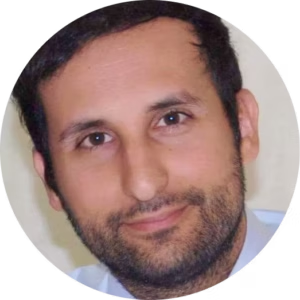 touchIMMUNOLOGY Future Leader, Dr Andreas Hadjinicolaou shared his insights:
“Aside from the world-class presentations, the highlight of UEG is always the networking — meeting like-minded people, exchanging ideas, and building collaborations. We’ve already generated three or four potential collaborations just by talking to people.”
He noted significant focus this year on molecular mechanisms in GI cancers, the oncobiome, and the development of non-invasive diagnostic tests. He also discussed the rising focus in early detection of GI cancers:
“There’s growing emphasis on early detection, not just in upper GI cancer but also through biomarkers for colorectal cancer and risk stratification for pancreatic lesions — essentially identifying patients that need surveillance or treating early.”
Joint action against liver cancer
At the conference in Berlin, United European Gastroenterology (UEG) together with the German Society for Gastroenterology, Digestive and Metabolic Diseases (DGVS) issued a joint statement highlighting the rapidly rising burden of hepatocellular carcinoma (HCC) in Europe, calling for urgent action in both prevention and early detection. They emphasised that HCC is increasingly driven by metabolic-associated steatotic liver disease (MASLD), viral hepatitis, alcohol misuse and unhealthy diets, and stressed that timely diagnosis is the key to reducing risk.
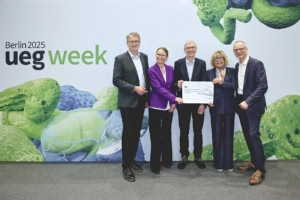
Their recommendations included:
- Tailored surveillance programmes based on individual risk
-
Public health initiatives targeting obesity, alcohol misuse and hepatitis transmission
-
Enhanced physician training in hepatology and nutrition
-
Equitable access to diagnostic tools and care pathways
Talking on the joint statement, Professor Birgit Terjung, DGVS board member concluded:
“Success depends on coordinated action at every level. From prevention and early detection to equitable access to care, governments, healthcare providers and the public all have a role to play if we are to turn the tide on liver cancer.”
Looking Ahead
UEG Week 2025 reaffirmed its status as the premier forum for digestive health innovation — a place where science, collaboration, and clinical practice converge to shape the future of gastroenterology. As the community looks toward UEG Week 2026, the conversations started in Berlin are set to drive continued progress in understanding, diagnosing, and treating digestive diseases worldwide.
See our highlights from UEG Week:
- Microplastics and gut health: First evidence of effects on human microbiome
- From mechanism to clinical impact: Dupilumab in children with eosinophilic esophagitis
- GLISTEN phase 3 trial: Linerixibat in cholestatic pruritus of primary biliary cholangitis
- Ongoing ASSURE trial demonstrates continued benefit and safety of seladelpar in primary biliary cholangitis
- Dupilumab provides long-term symptom relief at 100 weeks in children with eosinophilic esophagitis
- ZED1227 shows histologic improvement in symptomatic celiac disease: The phase 2b CEC-004/CEL trial
- Understanding the liver macrophage niche through intravital microscopy: Implications for disease and therapy
- Advancing early endoscopic detection of premalignant UGI conditions: Key insights from the PROSPERO study
This content has been developed independently by Touch Medical Media for touchIMMUNOLOGY. It is not affiliated with the United European Gastroenterology (UEG). Views expressed are the speaker’s own and do not necessarily reflect the views of Touch Medical Media.
Cite: UEG Week 2025: Innovation, collaboration and discovery in digestive health. touchIMMUNOLOGY. 21 October 2025.
Editor: Victoria Smith, Senior Content Editor.
Disclosures: This article was created by the touchIMMUNOLOGY team utilizing AI as an editorial tool (ChatGPT (GPT-4o) [Large language model]. https://chat.openai.com/chat.) The content was developed and edited by human editors. No funding was received in the publication of this article.
SIGN UP to TouchIMMUNOLOGY!
Join our global community today for access to thousands of peer-reviewed articles, expert insights, and learn-on-the-go education across 150+ specialties, plus concise email updates and newsletters so you never miss out.