Discover which meetings rheumatology specialists recommend and how to make every conference count.

With numerous national and international meetings taking place throughout the year, choosing which conferences to attend can be difficult. While scientific programs remain a major draw, opportunities for networking, collaboration, career development and presenting research are often just as valuable.
To help identify the meetings making the biggest impact across rheumatology, we asked members of the touchIMMUNOLOGY community to share the conferences they’re prioritizing this year and what makes them worth attending.
New insights are added regularly, covering a broad range of subspecialties and evolving clinical scenarios. Sign up below for Free Access to the latest clinical updates in your specialty!
The major meetings on our community’s radar
Unsurprisingly, two conferences consistently emerged as the leading international meetings in rheumatology: the European Alliance of Associations for Rheumatology (EULAR) Congress and American College of Rheumatology (ACR) Convergence.
Dr Vinod Ravindran (Centre for Rheumatology, Calicut, Kerala) identified both EULAR and ACR as his key international meetings, a view echoed by Prof. Jérôme Avouac (Cochin Hospital, Paris, France), who noted that each offers distinct strengths.
Prof. Avouac highlighted EULAR’s focus on “translational science,” “European collaborative networks” and “therapeutic innovation,” whereas ACR provides a complementary perspective through “large-scale clinical trials,” “real-world data” and “guideline updates” that directly influence clinical practice.
Prof. Yoshiya Tanaka (University of Occupational and Environmenal Health, Kitakyushu, Japan) described EULAR as the “most advanced and fruitful” meeting in the field, while Prof. Ade Adebajo (University of Sheffield, Sheffield, UK) highlighted its “cutting edge research updates, key networking and development of productive collaborations.”
Alongside these flagship meetings, Prof. Avouac also recommended the European Workshop for Rheumatology Research (EWRR), describing it as an ideal setting for “in-depth scientific exchange” in a “smaller, highly interactive setting.” Meanwhile, Dr Clive Kelly (James Cook University Hospital, Middlesbrough, UK) highlighted the British Society for Rheumatology (BSR) Annual Conference, reflecting the continued importance of national meetings alongside larger international congresses.
Beyond the science: what makes a conference worthwhile?
Although respondents recommended different meetings, there was remarkable consistency in what they considered the greatest value of attending.
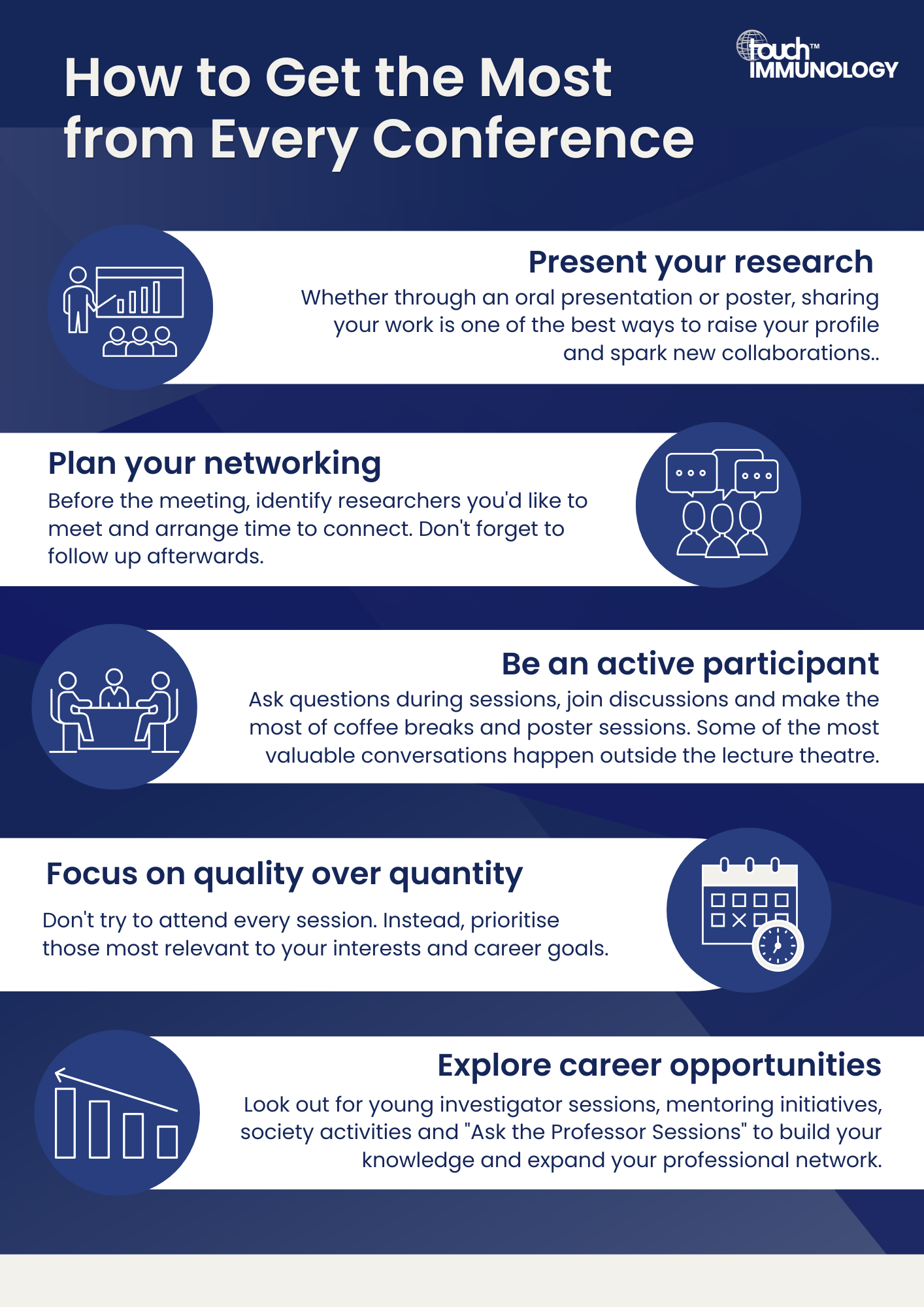
Networking was one of the strongest themes throughout the survey. Rather than simply listening to presentations, contributors encouraged delegates to actively engage with colleagues, mentors and potential collaborators.
Respondents highlighted the value of presenting research, participating in small-group discussions and making time for conversations during coffee breaks and poster sessions. Others recommended preparing before the meeting by identifying researchers whose work aligns with your interests and reaching out to arrange discussions during the conference.
Perhaps most importantly, contributors emphasized following up after the event. A brief email referencing a previous conversation can help transform an initial introduction into a long-term collaboration.
Making the most of early-career opportunities
For early-career clinicians and researchers, respondents agreed that conferences provide much more than educational sessions.
Presenting research—whether as an oral presentation or a poster—was consistently highlighted as one of the most valuable ways to gain visibility. As one respondent put it, “It is most useful to present your data and discuss it with a lot of participants.”
Mentorship and networking opportunities also featured prominently. Structured mentoring initiatives, young investigator sessions, awards programs and society-led activities were all recognized as valuable ways to build professional networks and strengthen an academic CV.
Several respondents also noted that while international meetings such as EULAR and ACR offer extensive opportunities, national and regional conferences may provide equally valuable experiences depending on your location, funding and career stage.
Practical advice for first-time attendees
Preparation emerged as one of the strongest pieces of advice for first-time delegates.
Rather than trying to attend every session, respondents recommended planning your schedule in advance and focusing on sessions that best align with your interests. They also encouraged attendees to identify key researchers they would like to meet before arriving at the conference.
Equally important was the advice to actively participate. Present your work, ask thoughtful questions after presentations and make the most of informal networking opportunities throughout the meeting. As one contributor noted, “A conference is not only about learning—it is about positioning yourself within a community.”
For those attending large congresses, contributors also recommended taking advantage of dedicated networking opportunities, including “Ask the Professor Sessions,” which can provide valuable opportunities to engage directly with experts.
Choosing the right conference for you
Rather than identifying a single “best” conference, the survey highlights the diverse opportunities available across rheumatology meetings, allowing attendees to choose those that best align with their interests and career goals.
International congresses such as EULAR and ACR continue to offer broad scientific programs, extensive networking opportunities and global collaborations, while national meetings and more specialized workshops provide valuable opportunities for focused discussion and career development.
Whichever conference you choose, one message was consistent throughout the responses: the greatest value comes from actively participating. Present your research, start conversations, seek out mentors and build relationships—these experiences can be just as valuable as the scientific program itself.
This content has been developed independently by Touch Medical Media for touchIMMUNOLOGY. This article was created by the touchIMMUNOLOGY team utilizing AI as an editorial tool (ChatGPT (GPT-4o) [Large language model]. https://chat.openai.com/chat.) No funding was received in the publication of this article.
Cite: Planning your conference calendar? Insights from the touchIMMUNOLOGY community. touchIMMUNOLOGY. July 2 2026.
Editor: Victoria Smith, Senior Content Editor.